Practice
Mastering Your Coding Practice Test: Proven Strategies 2026
A coding practice test scores behavior, not style. How hidden acceptance tests actually work, and how to prepare for the checks that decide whether you pass.
You open a coding practice test, skim the prompt, and your first instinct is to ask, “Am I supposed to make this pretty?” That reaction is normal. Many imagine a human reviewer judging style, but the machine is the one that decides whether your work passes, and that changes how you should prepare.
The hidden mechanic matters because a coding practice test is really a validation system. Your code is judged by automated test pass rates, not by how clever the solution sounds in your head. In practice, that means the safest path is usually the one that makes the expected behavior obvious, repeatable, and easy to verify.
What Actually Happens During a Coding Practice Test
You submit a solution, then the screen changes in a way that feels oddly final. That moment is easy to misread as a human verdict, but under the hood, the system is doing something much more mechanical. In a test-based practice environment, success is tied to whether your code satisfies the checks the platform runs against it, not whether it looks elegant to another person.
The machine is checking behavior, not intent
A good mental model is a vending machine. You press the button, the machine doesn't care what you meant to buy, it only cares whether the input matches a valid selection and the mechanism can complete the transaction. A coding practice test works the same way. If the function receives the right input and produces the right output, it passes.
That's why the score in some online practice models is explicitly the percentage of tests passed from W3Schools practice. The point isn't to guess whether your code is “probably right.” The point is to prove it through checks.
Practical rule: write code as if the platform is a strict teammate who only trusts evidence, not explanations.
The same logic shows up in real engineering work. Ticket-style development is incomplete until the code meets acceptance criteria and doesn't break existing behavior. That's why practice platforms lean so hard on pass or fail validation. They're training you for the part of engineering where “looks fine” doesn't count.
A simple example of the feedback loop
Suppose a prompt asks you to return the sum of two numbers. You write a function, click submit, and the platform runs it against a few examples you can see plus hidden ones you can't. If your function handles positive numbers but breaks on zero or negative values, you might still feel confident after the visible examples. The system won't.
That's the entire loop. You propose behavior, the computer checks behavior, and the result is either accepted or rejected. The smartest preparation starts with accepting that this is a verification process, not a performance review.
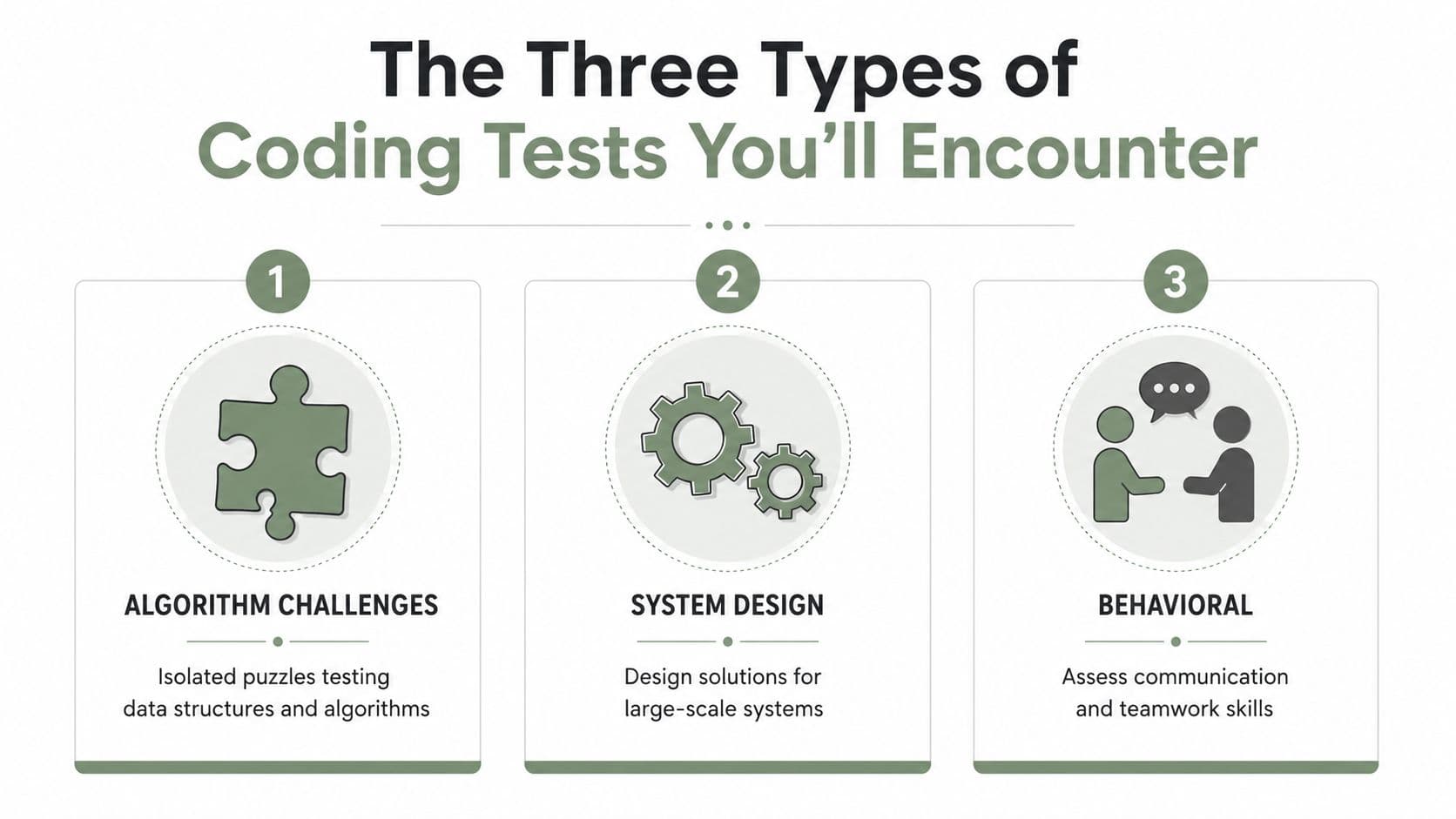
The Three Types of Coding Tests You'll Encounter
A lot of frustration comes from preparing for the wrong format. People use the same study habits for every interview or assessment, then wonder why their results feel inconsistent. Different test formats measure different abilities, and the platform you're using is usually signaling that through the structure of the work itself.
Algorithm challenges test isolated reasoning
Algorithm challenges are the puzzle-box version of a coding practice test. You're usually dealing with a narrow problem, a constrained input, and one or more correct outputs. The goal is to show that you can reason about data structures, logic, and edge cases without leaning on a large codebase.
These tasks resemble the kinds of drills you'll find on LeetCode and HackerRank, where the primary skill is solving an isolated problem under test conditions. They're useful, but they're not the same as maintaining a feature in production.
Take-home projects simulate delivery work
Take-home assignments ask for a broader slice of judgment. Instead of solving one narrow problem, you build something that feels more like a small feature or app. The evaluation often includes structure, completeness, and how well your work fits the prompt.
That makes this format closer to mini-delivery than puzzle solving. You're not just showing logic, you're showing how you organize work, make tradeoffs, and finish something end to end.
Ticket-based practice is closer to real engineering
Ticket-based practice is different again. The learner steps into an existing codebase, picks up a scoped task, and makes a change that has to pass hidden acceptance tests to count. That model reflects the kind of maintenance work junior engineers do every day, where the job is to understand the code that already exists and modify it safely.
Platforms in this space increasingly emphasize workflow simulation rather than isolated drills. DevSkiller's task categories, including arrays, data step, SAS, databases, frequency tables, statistics, ODS, reports, and macro language, show how practice is moving toward job-relevant work instead of abstract puzzles. Pearson's Statistics Exam Prep and related practice products, along with structured practice offerings from platforms such as Varsity Tutors, Study.com, Coursera, DataCamp, and W3Schools, point in the same direction.
The key is to identify the format early. If you're facing an algorithm challenge, practice focused problem solving. If you're facing a ticket-based practice environment, train on reading existing code, following acceptance criteria, and shipping changes that survive hidden checks.
How Hidden Acceptance Tests Really Work
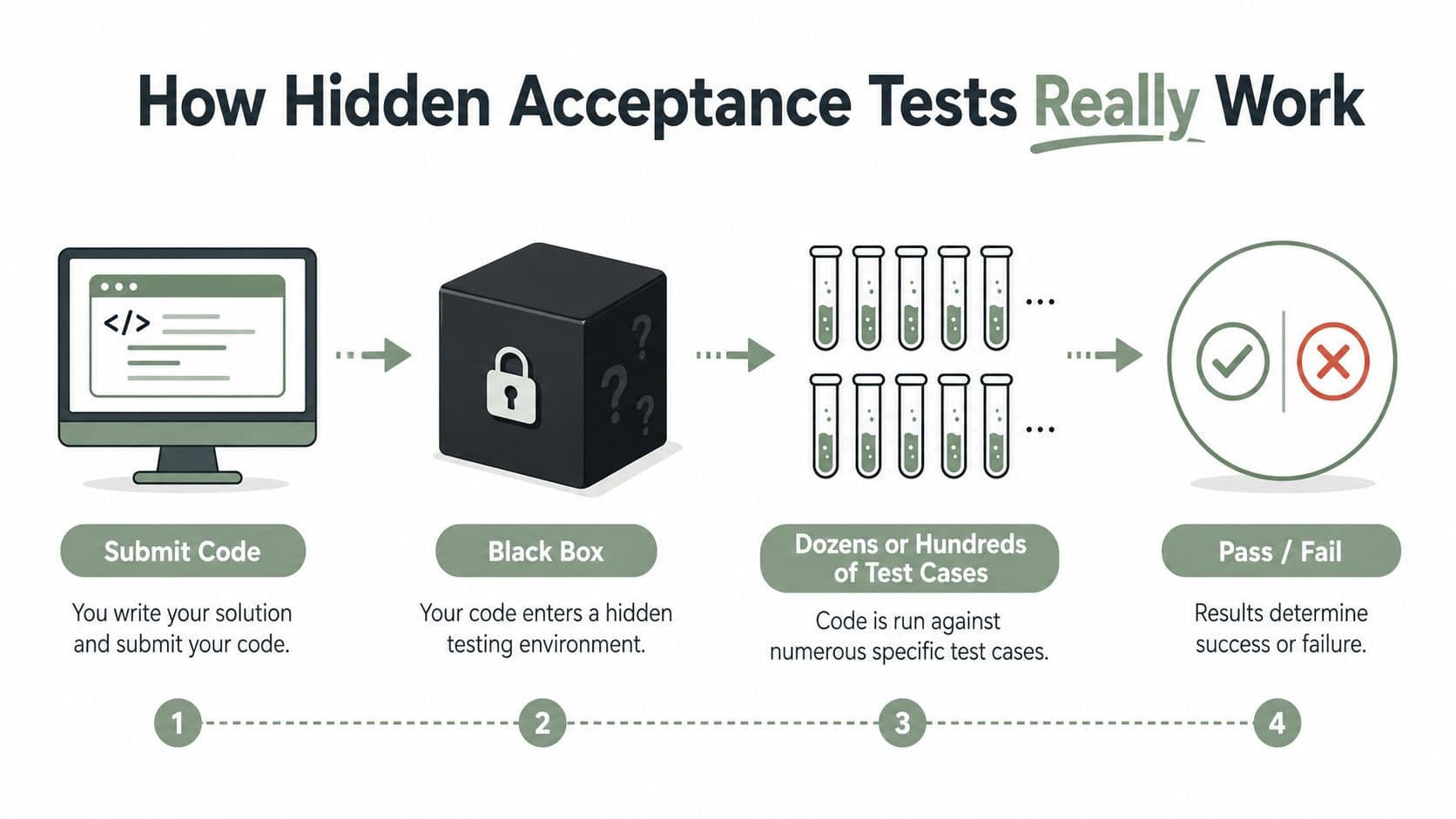
Hidden tests frustrate people because they feel arbitrary. You pass the visible examples, submit, and still fail. That usually means the platform found an input your code did not handle, not that the system is being capricious. The hidden checks are broader than the examples you saw, so they act like a wider net cast over the same problem.
The platform is verifying a contract
Every coding practice test has an implied contract. Your function or feature has to do a specific thing for a range of inputs, and the platform checks whether the behavior matches.
A thermostat makes this easier to understand. You do not care about the thermostat's internal mechanism if the room stays at the right temperature. The system does not care how polished your code looks if it does not meet the contract.
Hidden tests usually target the edges
Visible examples are there to show the shape of the problem. Hidden tests exist to catch weak assumptions. They often probe the places where people stop thinking, like empty inputs, repeated values, unusual ordering, or cases that only show up when the data is smaller or messier than expected.
A solution that only works for the example inputs is a demo, not a solution.
This is why acceptance criteria matter so much. In production work, a ticket is not done because the code compiled. It is done when it meets the stated requirements and does not break surrounding behavior. Hidden tests mimic that reality by checking whether the task works, not whether it merely appears to work.
Passing visible tests is not the finish line
A common trap is to stop once the sample output looks correct. That is the coding equivalent of checking the door is painted and assuming the lock works. Hidden acceptance tests push you to ask what the code should do in less obvious situations before you submit.
The useful habit is to read the prompt like a test writer would. Check what happens with empty values, repeated values, boundary cases, and inputs that arrive in a different order than the sample data. If a platform uses hidden checks, it is usually trying to separate lucky guesses from solutions that satisfy the contract.
Why Most Preparation Advice Fails
A lot of prep advice sounds productive because it's easy to do. You can grind problems, memorize patterns, or reread notes and feel busy. The problem is that many of those habits train recognition, not execution, and a coding practice test rewards execution under constraint.
Surface practice feels reassuring, but it doesn't transfer
If you memorize the answer to a common algorithm problem, you may recognize that pattern later. That still doesn't mean you can adapt when the prompt changes shape. Real tests rarely hand you the same framing twice, so recall alone doesn't hold up well when the inputs, edge cases, or surrounding code change.
The same issue appears when someone solves a lot of practice problems but never reviews why solutions fail. They've practiced doing problems, not diagnosing mistakes. That's a different skill.
Deep preparation builds the habits tests actually measure
The strongest preparation is slower and more deliberate. It looks like reading prompts carefully, identifying edge cases before coding, and learning how to debug when hidden tests fail. It also means practicing in environments that resemble the actual task, such as codebases with acceptance criteria rather than isolated toy exercises.
DevSkiller is a useful example of this shift because its task sets are organized around practical categories like databases, reports, and macro language, not just abstract algorithm puzzles. That structure reflects the kind of work learners are likely to do on the job.
Good prep asks, “What does this test really want?” Bad prep asks only, “Have I seen this problem before?”
There's also a mental trap here. Failing a test does not mean you're bad at coding. It usually means you found a gap in your preparation, and the test exposed it. That's useful information, not a verdict.
When people understand that distinction, they stop preparing for applause and start preparing for verification. That shift changes everything.
A Practical Framework for Effective Preparation
The best prep routine is boring in the right way. It's built around feedback, repetition, and honest review, not last-minute intensity. If you want your performance to improve, treat each session like a small experiment where the goal is to learn something specific from the result.
Start with a diagnostic pass
Don't begin by grinding random problems. Start by identifying where you're weak. You might be fine with loops and conditionals but shaky on edge cases, or comfortable reading code but slow when a prompt introduces unfamiliar structure. Diagnose first, then practice on purpose.
A simple way to do that is to take one task, solve it, and then review where you hesitated. Did you misunderstand the prompt? Did you miss an input case? Did you know the algorithm but struggle to implement it cleanly? That diagnosis tells you what to fix next.
Use the fail, analyze, fix loop
After you submit, don't jump straight to another task. Read the failure, inspect the mismatch, and isolate the cause. Then fix the root issue, not just the symptom. That loop is where most real learning happens.
If a solution fails because it breaks on empty input, don't just patch that case and move on. Write down why the bug happened. Did you assume there would always be at least one item? That assumption is the actual problem.
Train the same way you'll be tested
If the test is ticket-based, practice inside a codebase. If the assessment is timed, practice with a timer. If hidden acceptance criteria matter, always ask yourself what other inputs the platform might use. That's how you move from guessing to deliberate preparation.
One product in this space, Codeffice, gives learners scoped tickets inside a simulated engineering workflow with hidden acceptance tests. That matters because the learner is practicing the same basic loop used in real maintenance work, read the task, change the code, and verify it against checks.
Use a checklist before you submit
- Read the prompt twice: The first read gives you the shape, the second read catches details you skipped.
- List edge cases first: Empty input, repeated values, and unusual ordering should be on your radar before you code.
- Make the smallest correct change: Start simple, then refine only if the task needs more.
- Check your assumptions: If your logic depends on a hidden condition, name that condition explicitly.
This kind of prep doesn't just help you pass one test. It makes you harder to surprise.
Common Misconceptions That Sabotage Performance
A lot of capable developers underperform because they're carrying bad assumptions into the room. Those assumptions often sound disciplined, but they push people toward the wrong habits. Cleaning them up can be the difference between controlled execution and avoidable panic.
Perfection is not the goal
Some people try to write flawless code on the first pass. That sounds professional, but it usually slows them down and makes debugging harder. A better goal is to get to a correct, testable version quickly, then improve only where the task requires it.
That mindset matches how hidden acceptance tests work. The platform doesn't care whether your first draft was elegant. It cares whether the final behavior is right.
Speed without correctness is a dead end
Other people rush because they think being fast will save them. Speed matters, but only after you've understood the problem. If you move quickly in the wrong direction, you just fail faster.
The more useful habit is to think in checkpoints. Confirm the input shape, confirm the output expectation, then code. That small pause often prevents the kind of mistake that costs the most time later.
Memorizing answers is a weak substitute for understanding
It's tempting to stockpile solutions and hope you recognize one on test day. That approach breaks down the moment the prompt changes, because the question is no longer “Do I remember this?” It's “Can I reason through a new version of it?”
The goal isn't to become a library of answers. The goal is to become stable under unfamiliar inputs.
Another misconception is that a failed test says something about your worth. It doesn't. It says your current preparation missed something. That's exactly what a practice environment is for.
Building a Sustainable Practice Routine
Cramming creates the illusion of motion, but a coding practice test rewards habits you've repeated enough times that they feel ordinary. Sustainable practice works because it trains recall, debugging, and judgment under low drama. It also keeps you from burning out before you've built real momentum.
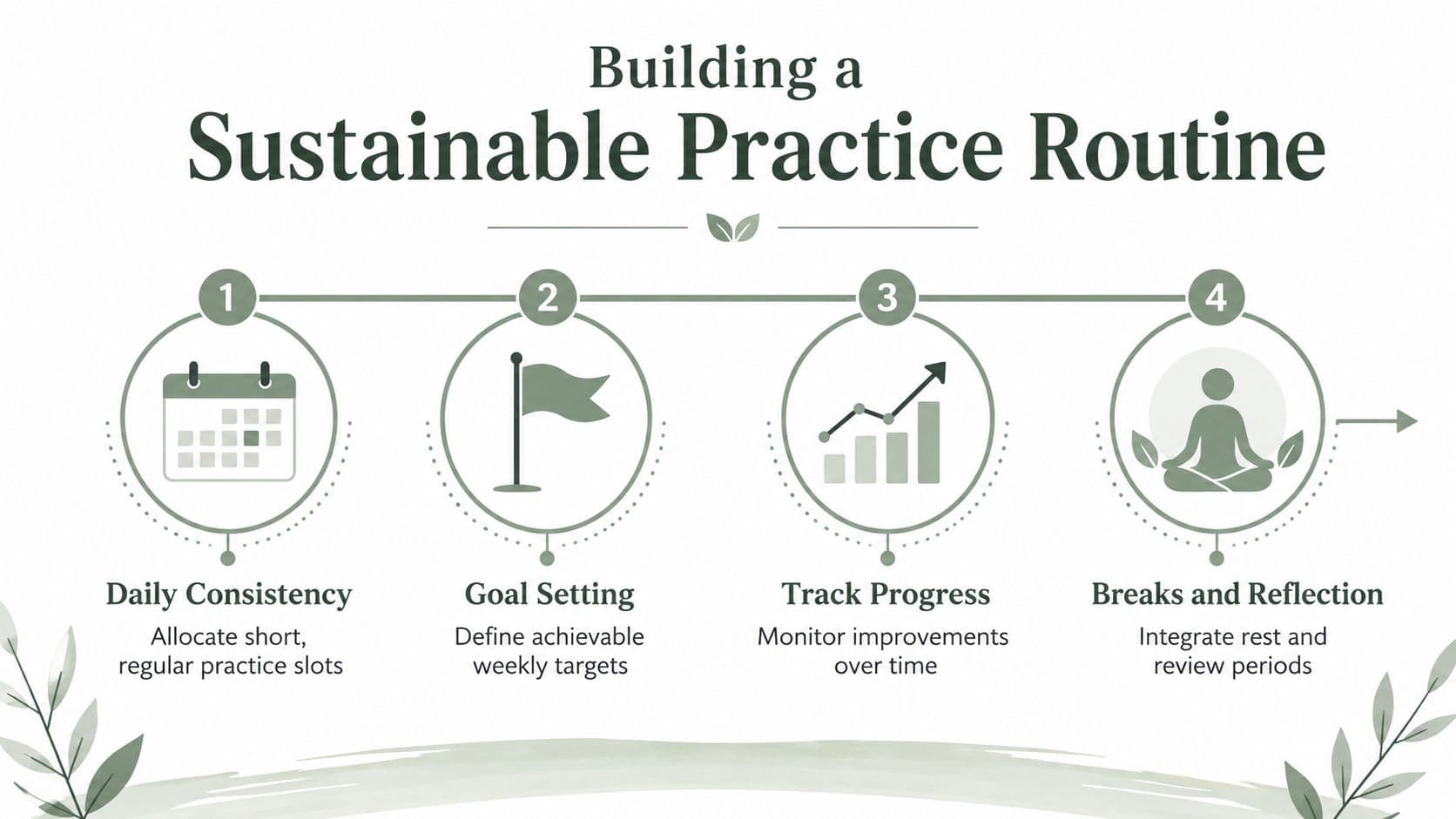
Make practice small and regular
Short, focused sessions are easier to repeat than marathon sessions that drain you. The goal is consistency, not theatrical intensity. If you can show up often enough to keep the problem-solving muscles active, you'll improve more steadily than someone who only studies when panic hits.
A good session has a clear start and finish. Solve one task, review what failed or felt shaky, and write down one lesson. That keeps the session useful even when you don't “win.”
Track improvement by behavior, not mood
Progress can feel invisible when you're inside it. That's why you should track specific behaviors, like whether you spotted edge cases earlier, whether debugging took less time, or whether you understood the prompt more quickly. Those are more reliable than vague feelings of confidence.
Use the test itself as your scoreboard. If your work is passing more of the checks or failing for narrower reasons, that's progress. It may not feel dramatic, but it's real.
Leave room for review and rest
Practice works better when you're rested enough to think clearly. If you're tired, you'll confuse exhaustion with lack of skill. That's a bad trade because it makes every hard problem feel personal.
The long game is simple. Repeat the cycle, notice where you fail, learn one thing each time, and come back fresh enough to use it.
If you want practice that feels closer to real engineering work, Codeffice gives you scoped tickets, hidden acceptance tests, and a browser-based environment designed for hands-on delivery. Visit Codeffice and use it to rehearse the same read, change, and verify loop that coding practice tests are really measuring.
Next in the tray
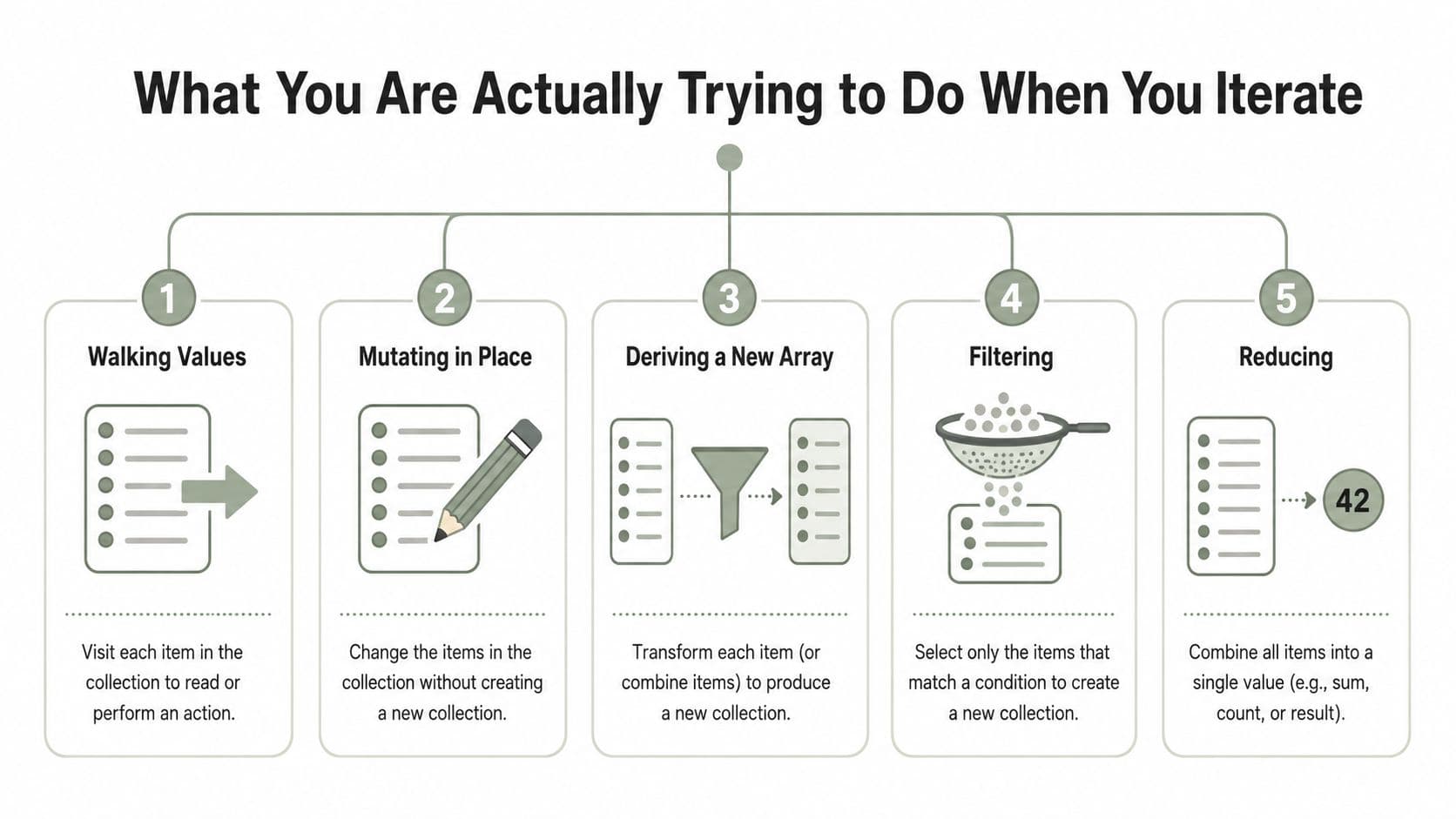
JavaScript Iterate Over Array: Proven Patterns for 2026
for, for...of, forEach, map, filter, reduce and custom iterators — which array iteration pattern fits the job, and where each one starts fighting you.
Read the file →
Complex in Python: A Practical Guide to Complex Numbers
What the j suffix means, when to reach for the built-in complex type, cmath or NumPy, and the branch-cut edge cases that quietly break numeric code.
Read the file →